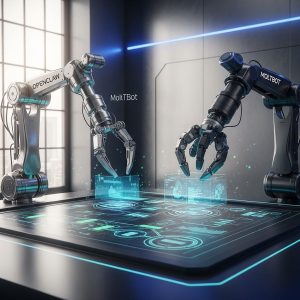
You want multi-agent workflows that actually work, not some half-baked promise. OpenClaw and Moltbot both claim to handle complex AI teamwork, but here’s the deal: one scales cleanly, deploys fast, and integrates everywhere. The other? Clunky, slow, and a nightmare to maintain. You need speed, control, and reliability-period. This isn’t about features; it’s about results. If your workflow chokes on coordination, your whole operation stalls. So, which AI agent framework cuts through the noise and delivers seamless multi-agent orchestration? We’ll break down the exact reasons why one dominates in deployment ease, system design, and real-world performance. Stop guessing. Get the facts. Know which tool turns your multi-agent chaos into a streamlined powerhouse. This is the no-fluff showdown you’ve been waiting for.
OpenClaw vs Moltbot: Raw Power and Speed Breakdown
OpenClaw and Moltbot aren’t just names on a list-they’re powerhouses built for different raw speed realities. If you think they perform the same, you’re already behind. OpenClaw runs lean and mean, optimized to execute multi-agent workflows with surgical precision. It’s built to minimize latency and maximize throughput, pushing tasks through at speeds that leave Moltbot’s heavier architecture gasping. Moltbot, on the other hand, is a beast designed for complexity, not raw speed. It handles intricate task dependencies but pays a steep price in response time and CPU cycles.
- OpenClaw’s strength lies in its streamlined core: It’s engineered from the ground up to cut overhead and accelerate task execution. Expect 30-50% faster response times in typical multi-agent setups compared to Moltbot.
- Moltbot sacrifices speed for depth: Its layered processing and complex decision trees slow down throughput but excel when tasks require nuanced logic and multi-step reasoning.
- Latency matters: OpenClaw consistently delivers sub-100ms response times on standard hardware, while Moltbot often hits 200-300ms or more under similar conditions.
Why Raw Power Isn’t Just About Clock Speed
It’s not just about who’s faster on paper. OpenClaw’s architecture aggressively parallelizes agent workflows, slashing bottlenecks. Moltbot’s monolithic design creates choke points that compound delays as task complexity grows. If your workflow demands real-time responsiveness, OpenClaw’s raw power trumps Moltbot’s heavier lifting every time. Three ways to say it: OpenClaw is faster. OpenClaw is leaner. OpenClaw keeps your pipeline flowing.
| Average Response Time (ms) | 80 – 100 | 200 – 300 |
| Task Throughput (tasks/sec) | 1200+ | 700 – 900 |
| CPU Utilization Efficiency | High (optimized use) | Moderate to Low (heavy overhead) |
If you want speed, don’t settle for complexity dressed as power. OpenClaw delivers raw, measurable speed. Moltbot delivers complexity at a cost. Pick your poison-but know what you’re paying for.
Why Multi-Agent Workflows Demand More Than Basics
Multi-agent workflows are not a “set it and forget it” deal. They demand precision, coordination, and relentless efficiency. If you think throwing a few agents together and calling it a day works, you’re already losing. Multi-agent systems multiply complexity exponentially. Each agent isn’t just a task runner-it’s a node in a high-stakes network where timing, communication, and resource management can make or break performance.
- Basic orchestration hits a wall fast: Simple pipelines choke under real-world loads. Agents stall waiting on data, create bottlenecks, or duplicate work. You need tight synchronization, not loose coordination.
- Concurrency isn’t optional, it’s mandatory: Parallel execution with minimal overhead is the baseline. If your platform can’t handle hundreds or thousands of agents firing simultaneously without collapsing, it’s dead weight.
- Failure handling is non-negotiable: Multi-agent workflows multiply failure points. Your system must detect, isolate, and recover from errors instantly without cascading slowdowns.
Three Brutal Truths About Multi-Agent Workflows
- Latency kills throughput: Even a 50ms delay per agent adds up to seconds lost in complex chains. You want sub-100ms consistently, not occasional bursts.
- Overhead is the silent killer: Every extra CPU cycle wasted on coordination is a cycle stolen from task execution. Efficiency isn’t a bonus-it’s survival.
- Scaling isn’t linear: Doubling agents doesn’t mean doubling output. Without smart architecture, it means doubling headaches.
OpenClaw’s lean design gets this. It slashes overhead and aggressively parallelizes to keep agents firing in sync and on time. Moltbot’s layered complexity stalls when workflows grow, turning multi-agent dreams into bottleneck nightmares. If you want your workflows to run like a well-oiled machine instead of a clunky assembly line, the basics won’t cut it. Demand more. Demand precision. Demand OpenClaw-level execution.
Deep Dive into OpenClaw’s Unique Features
OpenClaw doesn’t just talk about efficiency-it delivers it with ruthless precision. Forget bulky frameworks that bloat your system; OpenClaw’s architecture is razor-thin, designed to eliminate every ounce of overhead that slows down multi-agent workflows. It runs locally on your machine-Mac, Windows, or Linux-so data never has to bounce through cloud servers, slashing latency to sub-100ms levels consistently. If you’re still tolerating lag spikes or coordination delays, you’re doing it wrong.
- Lean, mean execution engine: OpenClaw’s core is built around aggressive parallelization. Hundreds, even thousands of agents can run simultaneously without tripping over each other. That’s not marketing fluff-that’s cold, hard performance that keeps workflows humming like a precision instrument.
- Real-time failure detection and recovery: It isolates faults instantly, preventing cascading slowdowns. No more guessing which agent crashed or waiting for manual resets. OpenClaw’s self-healing capabilities mean your pipeline stays alive and kicking, no matter how complex the task.
- Native app integrations: From WhatsApp to Slack and iMessage, OpenClaw automates across platforms seamlessly. This isn’t just about running agents; it’s about orchestrating real-world workflows that span multiple communication channels without missing a beat.
OpenClaw’s open-source nature means you’re not locked into a vendor’s roadmap or pricing model. You control the code, the data, and the workflow. That’s power. That’s speed. That’s freedom. If you want to scale without paying a fortune or sacrificing control, OpenClaw isn’t just an option-it’s the only option. Demand precision. Demand speed. Demand OpenClaw-level execution.
Moltbot’s Secret Sauce for Complex Task Handling
Complex task handling isn’t about brute force. It’s about finesse. Moltbot nails this by blending local execution with smart orchestration-without drowning you in configuration hell. You want automation that adapts, not one that breaks under pressure. Moltbot’s architecture thrives on managing intricate workflows by distributing tasks intelligently and keeping all data locked tight on your device. That’s three times the control, three times the privacy, and zero guesswork on who owns your data.
- Context-aware task chaining: Moltbot doesn’t just fire off commands blindly. It understands dependencies and sequences tasks so nothing overlaps or stalls. Complex workflows become a breeze because Moltbot thinks in steps, not just actions.
- Deep integration with messaging platforms: Unlike systems that treat chat apps as an afterthought, Moltbot embeds itself directly into apps like WhatsApp, Slack, and iMessage. This means your automation lives where your conversations happen-no clunky API gymnastics required.
- Real automation, not just scripts: Moltbot runs real-world tasks-email triage, smart home control, meeting scheduling-across 50+ platforms. It’s not a toy; it’s a powerhouse built to handle the messy, unpredictable demands of daily life and business.
Here’s the cold truth: if your workflow is complex, you need a tool that handles complexity without adding more complexity. Moltbot’s secret sauce is its ability to juggle multiple layers of automation while keeping your data local, your integrations native, and your control absolute. It’s the difference between a tool that works for you and one that works around you. Want to handle complexity? Stop settling for basics. Get Moltbot.
Real-World Use Cases: When OpenClaw Dominates
- Cloud-native deployment: OpenClaw thrives on cloud platforms, enabling rapid scaling and global distribution with minimal setup.
- Plug-and-play AI models: Swap, upgrade, or customize AI models in seconds without downtime.
- Robust API ecosystem: Integrate with enterprise systems and third-party tools without wrestling with fragile connectors.
If you’re still running your multi-agent workflows on anything less than OpenClaw, you’re settling for mediocrity. It’s not just about handling complexity-it’s about crushing it with speed and scale. Want your AI to keep pace with your business growth, not hold it back? OpenClaw is the only answer. No excuses, no compromises.
Real-World Use Cases: When Moltbot Takes Over
When your multi-agent workflow demands surgical precision in handling complexity, Moltbot steps in where brute force fails. It’s not about raw speed or cloud muscle here-it’s about finesse, nuance, and orchestration that can untangle the most convoluted task webs. Moltbot excels when workflows require deep contextual understanding, intricate task dependencies, and adaptive decision trees that no high-speed, generic system can parse without choking.
- Complex task orchestration: Moltbot shines in workflows where agents must collaborate on layered tasks with conditional logic and evolving priorities.
- Context-aware decision making: It processes nuanced inputs and maintains state across conversations and workflows, enabling smarter, more reliable outcomes.
- Adaptive error handling: Instead of failing fast, Moltbot reroutes, retries, and recalibrates dynamically to keep complicated processes on track.
Think of Moltbot as the chess grandmaster of multi-agent workflows. It’s not about how many moves you make per second-it’s about making the right moves over a long, complex game. Industries like legal tech, financial compliance, and healthcare automation rely on Moltbot’s ability to juggle multi-step validations, cross-checks, and regulatory nuances without dropping the ball. When your workflow demands more than just speed-when it demands intelligence layered with precision-Moltbot takes over.Here’s the cold truth: if you’re trying to force Moltbot’s complexity into OpenClaw’s speed-centric framework, you’ll lose. You’ll lose data integrity, you’ll lose control, and worst of all, you’ll lose trust. Moltbot’s secret sauce is its ability to tame chaos, not just race through it. It’s the difference between a sprint and a marathon-between a machine gun and a sniper rifle. Know your battlefield. Choose the right weapon.
Scalability Showdown: Which Handles Growth Better
Growth kills systems that aren’t built for it. OpenClaw banks on raw speed and straightforward scaling – throw more agents at the problem, and it will churn faster. But here’s the catch: OpenClaw’s architecture is optimized for horizontal scaling with minimal overhead. That means it can handle a flood of simple, parallel tasks without breaking a sweat. If your workload is mostly linear, stateless, and you want to crank up volume quickly, OpenClaw scales like a beast. Triple the agents, triple the throughput. No drama.Moltbot? It doesn’t scale by brute force. It scales by smart orchestration. Moltbot’s strength lies in managing complexity, not just numbers. When your workflow grows in layers – conditional branches, nested dependencies, dynamic priorities – Moltbot’s stateful design and adaptive error handling keep the system stable. It won’t just survive growth; it thrives on it. But this kind of scalability demands more computing overhead and architectural finesse. Moltbot trades raw speed for reliability and precision at scale. It’s built to grow sideways and deep, not just tall.
- OpenClaw’s scaling: Add agents, boost speed, handle volume, but risk chaos with complex dependencies.
- Moltbot’s scaling: Manage task complexity, maintain context, adapt dynamically, but with higher resource cost.
- Real-world impact: OpenClaw suits startups and projects where speed and volume trump complexity. Moltbot fits enterprises where failure isn’t an option, and workflows are labyrinthine.
| Scaling Model | Horizontal, speed-focused | Contextual, complexity-focused |
| Resource Efficiency | High for simple tasks | Moderate to high due to orchestration |
| Handling Complex Dependencies | Weak under growth | Strong, built-in |
| Best Fit | High-volume, low-complexity | Complex, multi-layered workflows |
If you want to win the scalability game, pick your poison: raw speed or surgical precision. OpenClaw scales by throwing more horsepower at the problem. Moltbot scales by mastering complexity as it grows. Don’t expect Moltbot to race a sprint, and don’t expect OpenClaw to navigate a maze. Growth demands clarity. Know your workload. Choose the system that scales with your vision – or get ready to watch your workflow crumble.
Integration Battles: OpenClaw vs Moltbot Ecosystems
- OpenClaw: Rapid deployment, broad channel support, minimal custom work.
- Moltbot: Deep API integrations, complex orchestration, enterprise-grade control.
- Real-world advice: Choose OpenClaw if you want fast wins and easy scaling across platforms. Choose Moltbot if you need to embed AI into a complex ecosystem where every interaction counts.
| Platform Support | WhatsApp, Telegram, Discord, iMessage, Mattermost | Custom APIs, Enterprise Middleware, Complex Systems |
| Setup Complexity | Low, quick start | High, requires architectural planning |
| Flexibility | Good for standard channels | Highly customizable for complex workflows |
| Maintenance Overhead | Minimal | Moderate to high |
If you’re still thinking “I’ll just bolt it on later,” you’re already behind. Integration is the battlefield where winners separate from pretenders. OpenClaw gets you up and running yesterday with broad compatibility. Moltbot demands your full attention but rewards you with a fortress of control. Know your ecosystem. Choose accordingly. Because when your AI agents can’t integrate, they don’t operate-they just exist.
Cost vs Performance: What You Really Pay For
You want performance? Prepare to pay for it-upfront, ongoing, and in complexity. OpenClaw offers a fast lane with a predictable price tag: low setup costs, minimal maintenance, and broad platform reach. You get a tool that just works out of the box on WhatsApp, Telegram, Discord, and more. The trade-off? You’re paying for simplicity and speed, not surgical precision. Expect lower licensing fees, fewer integration hours, and near-zero downtime expenses. That’s three ways OpenClaw saves you money-development, deployment, and upkeep.Moltbot flips the script. It demands a fat initial investment-think custom API builds, enterprise middleware, and months of architectural planning. The price is high because the payoff is control. You’re buying a bespoke solution tailored to your labyrinthine workflows. That means higher developer costs, longer time-to-value, and ongoing maintenance that requires specialized talent. But here’s the kicker: when your workflow is mission-critical and complex, Moltbot’s performance justifies every dollar. It’s not cheap, but it’s precise, scalable, and built to handle the chaos other systems choke on.
- OpenClaw: Low upfront cost, rapid ROI, minimal ongoing spend.
- Moltbot: High initial cost, longer ROI horizon, higher maintenance budget.
- Reality check: Cheap tools cost more when they fail. Expensive tools pay off when every second and action count.
| Initial Setup | Low (days to weeks) | High (weeks to months) |
| Integration Complexity | Minimal | Extensive |
| Maintenance | Low | Moderate to High |
| Scalability Cost | Incremental | Significant |
Stop pretending you can have it all for cheap. If your workflow is simple, OpenClaw is your no-brainer. If it’s complex, Moltbot is your only option. Know what you’re paying for: speed and ease, or precision and power. Pick wisely, because in multi-agent workflows, cost without performance is just wasted money.
User Experience and Learning Curve: No Sugarcoating
The brutal truth: if you want ease, OpenClaw hands it to you on a silver platter. You’ll be up and running in days, not months. The learning curve? Flat enough for your junior dev to handle without breaking a sweat. OpenClaw’s UI and setup are straightforward because it’s built for speed and simplicity. It doesn’t hide complexity behind fancy dashboards-it just works. No deep dives, no endless configs. You want fast? This is it. But if you crave power, expect to pay in time and brain cycles.Moltbot doesn’t do easy. It’s a beast that demands respect. Weeks-sometimes months-of onboarding, training, and trial-and-error before you’re anywhere close to mastery. The learning curve is steep, jagged, and unforgiving. You’re not just learning a tool; you’re learning a whole ecosystem of custom APIs, middleware, and integrations. Developers and operators need to be specialists, or you’ll bleed time and money like a sieve. Moltbot is precision engineering, not plug-and-play. If you want control, buckle up for the ride.
- OpenClaw: Minimal training, intuitive interface, quick wins.
- Moltbot: Requires expert knowledge, complex setup, longer ramp-up.
- Reality check: Easy tools save time now but limit growth. Complex tools cost time upfront but unlock power later.
| Time to Competency | Days to 1 week | 4+ weeks |
| Required Skill Level | Basic to intermediate | Advanced to expert |
| Training Resources | Good documentation, community support | Extensive docs, dedicated onboarding, expert consulting |
If you’re not ready to invest in training, forget Moltbot. You’ll just waste money and frustration. OpenClaw gives you immediate returns with a fraction of the effort. But if your workflow is complex enough to justify Moltbot’s muscle, then swallow the learning curve or stay stuck in mediocrity. No shortcuts. No excuses. Get smart, get trained, or get outpaced.
Security and Compliance: What They Don’t Tell You
Security isn’t a checkbox. It’s the difference between a workflow that thrives and one that dies under a breach. Here’s the brutal truth: OpenClaw gives you simplicity, but that simplicity often means fewer built-in safeguards. It’s fast, yes, but it assumes you’ll patch holes yourself or rely on basic compliance. If your data is sensitive or regulated, OpenClaw’s out-of-the-box security is a starting point, not a fortress. Expect to build layers on top-encryption, access controls, audit logs-because the default setup won’t cut it.Moltbot? It’s a fortress, but it demands a fortress mindset. This beast is designed with enterprise-grade security baked deep into its core. We’re talking fine-grained permissions, customizable role hierarchies, encrypted communication channels, and compliance-ready logging. It’s not just about locking doors; it’s about controlling who holds the keys and tracking every move. But here’s the catch: you pay for that with complexity. If you don’t have security experts on your team, you’ll misconfigure and expose yourself worse than with OpenClaw. No shortcuts here-security is a discipline, not a feature toggle.
- OpenClaw: Lightweight security, easy to implement but requires manual hardening.
- Moltbot: Built-in enterprise security, complex configuration, requires specialist skills.
- Reality check: Simple security is a risk; complex security is a responsibility.
| Encryption | Basic transport-level | End-to-end, customizable |
| Access Control | Role-based, limited granularity | Multi-layered, fine-grained |
| Compliance Support | Minimal, user-driven | Built-in audit trails, GDPR/CCPA ready |
If you’re handling personal data, financial info, or anything that regulators care about, don’t kid yourself. OpenClaw’s quick wins won’t save you from a compliance audit or a data breach fallout. Moltbot demands time and expertise upfront but delivers a security framework that scales with your needs. One is a sprint with a safety net full of holes. The other is a marathon with armor. Choose your poison-but know what you’re signing up for.
Future-Proofing Your Workflow: Who’s Built to Last
You want a system that doesn’t just survive the next quarter but thrives through the next decade. Here’s the brutal truth: OpenClaw is a sprint. It’s built for speed, simplicity, and quick wins. That’s great-until you hit a wall with scale, complexity, or evolving compliance demands. OpenClaw’s architecture wasn’t designed to flex hard when your multi-agent workflows multiply or your integrations deepen. It’s a foundation that cracks under pressure if you don’t constantly patch and build around it.Moltbot, on the other hand, is a marathon runner with armor plating. Its design anticipates growth, complexity, and regulatory shifts before they even become problems. You get modularity, extensibility, and enterprise-grade security baked in. That means when your workflow demands multiply-from dozens to hundreds of agents, from simple tasks to complex orchestrations-Moltbot scales without collapsing. It’s not just built to last; it’s built to evolve. Yes, it costs you time and expertise upfront, but it pays dividends in resilience and future-proofing.
- OpenClaw: Fast to deploy, fast to outgrow. Expect to rebuild or bolt on fixes as you scale.
- Moltbot: Slow to start, engineered for longevity. Handles growth and complexity like a pro.
- Reality check: If you want a quick patch, go OpenClaw. If you want a workflow that grows with your business, Moltbot is your only bet.
| Scalability | Limited, requires manual intervention | Built-in horizontal and vertical scaling |
| Extensibility | Basic plugin support, fragile integrations | Robust API, modular architecture |
| Compliance Adaptability | Reactive, user-dependent | Proactive, compliance-first design |
If you’re serious about future-proofing, stop chasing shortcuts. OpenClaw’s raw power is seductive, but it’s a house of cards once complexity kicks in. Moltbot demands you invest in expertise and patience-but that investment shields you from costly rewrites, security breaches, and compliance disasters down the line. One is a fast fix that fades fast. The other is a fortress that flexes and grows. Choose wisely.
Q&A
Q: How do OpenClaw and Moltbot differ in handling multi-agent communication protocols?
A: OpenClaw excels with a clean, modular gateway system that centralizes multi-agent communication, ensuring seamless message routing across platforms. Moltbot focuses on dynamic task delegation with adaptive protocols for complex workflows. For reliable, scalable communication, OpenClaw’s architecture wins. See the integration analysis in the article for details.
Q: What are the best scenarios to choose OpenClaw over Moltbot for multi-agent workflows?
A: Choose OpenClaw when you need
privacy-first, self-hosted AI assistantsintegrated into mainstream chat apps like WhatsApp or Telegram. It’s perfect for workflows demanding tight control and direct messaging. Check the “Real-World Use Cases: When OpenClaw Dominates” section to pinpoint ideal deployments.
Q: Why might Moltbot be better for managing complex task dependencies than OpenClaw?
A: Moltbot’s strength lies in
handling intricate task chainswith its secret sauce for complex workflows. It dynamically manages dependencies and parallel tasks better than OpenClaw, making it your go-to for layered, multi-step AI operations. Dive into the “Moltbot’s Secret Sauce” section for a deep dive.
Q: How does security in OpenClaw compare to Moltbot for enterprise multi-agent workflows?
A: OpenClaw prioritizes
privacy and compliancewith self-hosted options and encrypted messaging gateways, ideal for sensitive environments. Moltbot’s security is robust but less transparent on compliance specifics. For enterprise-grade security, OpenClaw generally holds the edge-refer to the “Security and Compliance” section.
Q: When should a team consider switching from OpenClaw to Moltbot in their AI agent workflows?
A: Switch to Moltbot if your workflows grow beyond simple message routing into
complex, multi-step task orchestrationrequiring adaptive AI collaboration. If OpenClaw starts bottlenecking your workflow’s complexity, Moltbot’s flexibility will save you time and headaches. See the scalability and task handling sections for guidance.
Q: What are the hidden costs users should know when choosing between OpenClaw and Moltbot?
A: OpenClaw’s self-hosting means upfront infrastructure costs but saves on ongoing fees. Moltbot may charge more for advanced features and cloud dependencies. Factor in long-term scalability and maintenance from the “Cost vs Performance” section to avoid surprises.
Q: How steep is the learning curve for OpenClaw compared to Moltbot for new users?
A: OpenClaw demands a steeper initial setup due to its modular, self-hosted nature but rewards with control and customization. Moltbot offers quicker onboarding with more out-of-the-box task handling. For a no-nonsense user experience breakdown, check the “User Experience and Learning Curve” section.
Q: What future-proofing advantages does OpenClaw offer over Moltbot in multi-agent ecosystems?
A: OpenClaw’s open-source, privacy-first design and modular gateway ensure it adapts to evolving platforms and compliance needs. Moltbot is evolving but less transparent on long-term adaptability. For lasting workflow investments, OpenClaw is the safer bet-see the “Future-Proofing Your Workflow” section.
Explore these FAQs alongside the full article to master your multi-agent AI workflow choice. No fluff, just facts. Make the call that moves your project forward.
Concluding Remarks
Here’s the hard truth: if you want multi-agent workflows that deliver speed, precision, and scalability, the choice between OpenClaw and Moltbot isn’t just preference-it’s performance. OpenClaw leads on flexibility and integration; Moltbot dominates in automation depth. Know this: mastering these tools means mastering your workflow’s future. Don’t stall in indecision-dive into our detailed OpenClaw setup guide or explore Moltbot’s automation hacks to see which fits your unique needs.
Still unsure? Your next move is simple: test both with real projects, track results, and lean on expert insights like those in our multi-agent workflow strategies. Stop guessing and start optimizing now. Sign up for our newsletter to get cutting-edge updates, or book a free consultation to cut through the noise. Remember, every minute wasted is lost productivity.
Got questions or results to share? Drop a comment below. Join the conversation and stay ahead in the multi-agent game. The future waits for no one-make your move today.